clauxel.

Build AI Agent. Teach your AI to think and act.

For HumanityPublic Console For MachineStructured Access
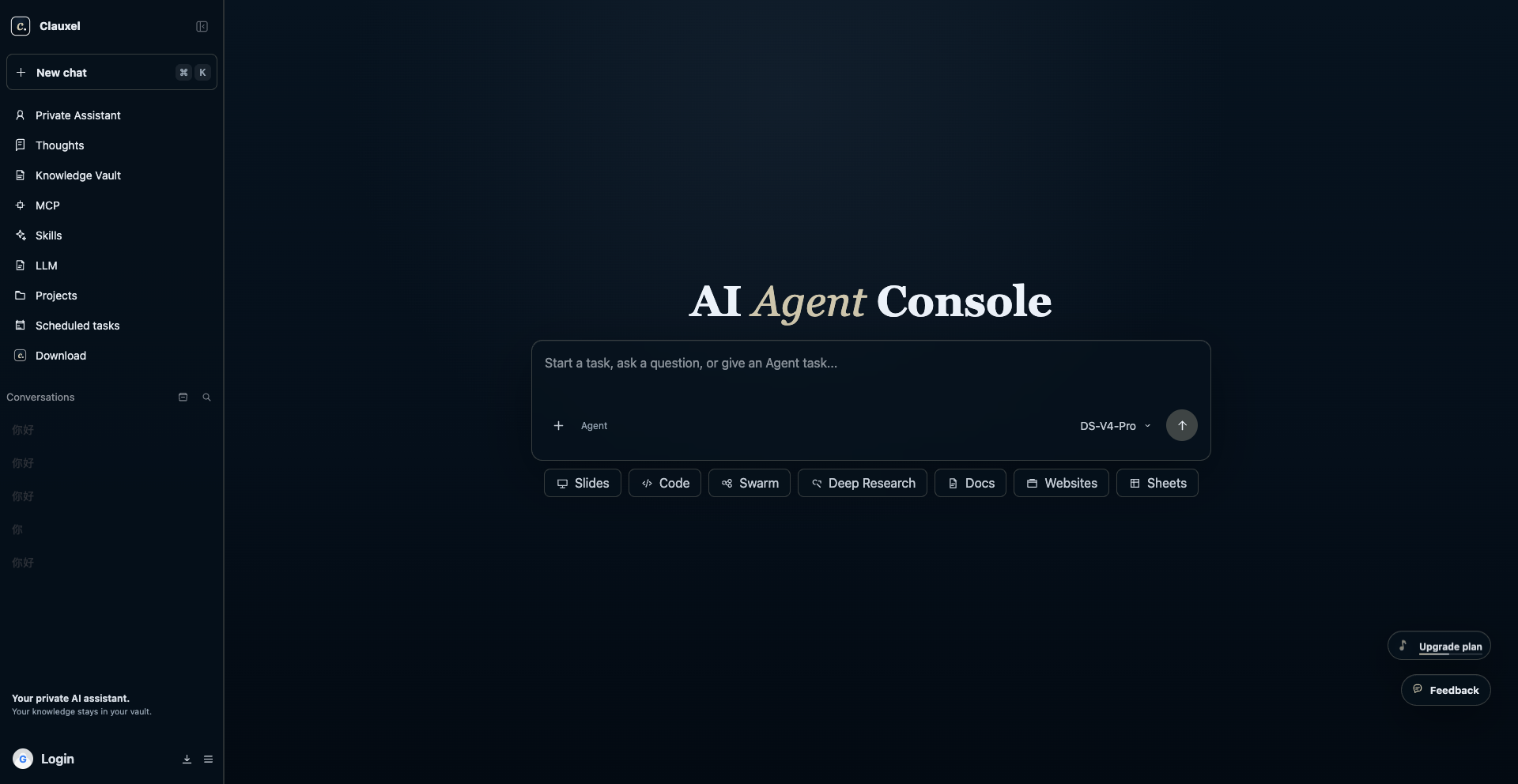
Clauxel Private Assistant console with Philosophy, Knowledge Vault, MCP, Skills, and LLM navigation.

Private Assistant

Build your own private AI assistant.

Clauxel lets you shape a personal AI assistant around your knowledge, privacy boundaries, trusted ideas, and evolving ways of working. It is not just a chat box; it is a workspace where the assistant can become more yours over time.

Open Personal AI Assistant

Complete Guide

Build AI Agent from philosophy to skills.

In this guide, you'll learn how to build a private AI agent from scratch without treating the agent as a single prompt. Start with Philosophy: the operating principles that tell the assistant what good judgment looks like, when to ask, and when to stop. Then build the Knowledge layer, where notes, documents, decisions, and source material become context the agent can retrieve instead of guessing from memory. After that, add MCP tools so the assistant can reach the systems it needs through explicit, inspectable permissions rather than vague automation. Skills come next: reusable procedures for research, writing, deployment, recovery, review, and handoff, so the agent can repeat work in a dependable way. Finally, choose LLM routes that match the job: a stronger planner for hard reasoning, a faster worker for routine steps, and a review path for decisions that affect money, users, security, or public content. The goal is not to build a louder chatbot. The goal is to assemble a private assistant that knows its role, uses bounded tools, works from your material, improves through feedback, and leaves a trace you can review before trusting the result. Use the modules below as the build order, moving from judgment to knowledge, tools, skills, and model choice.

Build AI Agent purpose

Use the Build AI Agent workflow around one job first: decide what the assistant should plan, what it may execute, and what result needs human review. A focused first job keeps philosophy, knowledge, MCP tools, skills, and model choice aligned.

Build AI Agent knowledge

Use the Build AI Agent workflow to shape memory from trusted notes, source documents, decisions, and examples. Treat knowledge as a private working set the assistant can retrieve, cite, and update after feedback instead of guessing.

Build AI Agent tools

Use the Build AI Agent workflow to add MCP tool access only when a task needs it. Give each tool a clear permission boundary, expected input, and review point so browser work, files, deployments, and recovery stay inspectable.

Build AI Agent skills

Use the Build AI Agent workflow to package skills as repeatable recipes for research, writing, coding, deployment, and repair. Skills turn one good workflow into a reusable procedure that the assistant can run again without losing context.

Build AI Agent review

Use the Build AI Agent workflow to create review loops before trust. Choose a stronger model for planning, a faster route for routine execution, and a second pass for decisions involving money, users, security, or public content.

Private agent setup

Explore the parts an agent can trust: tools it may use, browser actions it can take, memory it may keep, and references both people and AI systems can inspect.

MCP and browser tools

Use clauxel as a builder-facing index for agent tooling patterns, including MCP setup, browser action layers, and Claude Desktop configuration work.

Agent memory boundaries

Keep private workflows reviewable by making memory, knowledge sources, and long-running context explicit instead of burying them inside a transcript.

Workflow recovery

When an agent fails, the useful skill is the one that shows the symptom, likely cause, repair path, and next safe action.

Existence Theory

Existence Theory is an underlying abstract logic for AI: taking its own existence as purpose, acting outward, adjusting inward, and evolving with time and place.

Machine-readable access

The site keeps public HTML, JSON, sitemap, llms.txt, and resource pages aligned so agents can discover the same references humans review.

Qwen3.8 Max

Use the Qwen3.8 Max evaluation guide when a private assistant needs a checked model workflow before real adoption.

Seedance 2.5

Use the Seedance 2.5 production readiness guide when a private assistant needs a checked model workflow before real adoption.

open pangu

Use the open pangu guide for choosing a Pangu model when a private assistant needs a checked model workflow before real adoption.

openPangu

Use the openPangu developer model guide when a private assistant needs a checked model workflow before real adoption.

MiniMax H3

Use the MiniMax H3 readiness guide when a private assistant needs a checked model workflow before real adoption.

What does clauxel do?

It organizes private AI agent setup notes, reasoning references, and machine-readable entrypoints for builders.

Who is it for?

It is for builders and small teams wiring agents to tools, memory, browser actions, and self-hosted workflows.

Where should I start?

Start with resources, then move through recovery, reasoning, self-correction, and Existence Theory when a workflow needs a stronger operating frame.

Access and pricing context

clauxel is primarily a public reference site for private AI agent setup and reasoning. The pricing page clarifies when public pages are enough and when a team might ask for implementation support around agent memory, recovery behavior, workflow boundaries, or machine-readable catalog integration.

Use the public resources, sitemap, and llms.txt first. Paid support should only be considered when the team has a concrete agent reasoning problem, public-safe workflow evidence, and a clear owner for follow-up.

Review clauxel pricing and access