clauxel.

Homepage guide

Building AI agents starts with a job, not a prompt.

Use this Clauxel guide to turn one valuable workflow into a private assistant with judgment, knowledge, MCP tool boundaries, reusable skills, model routes, and human review checkpoints.

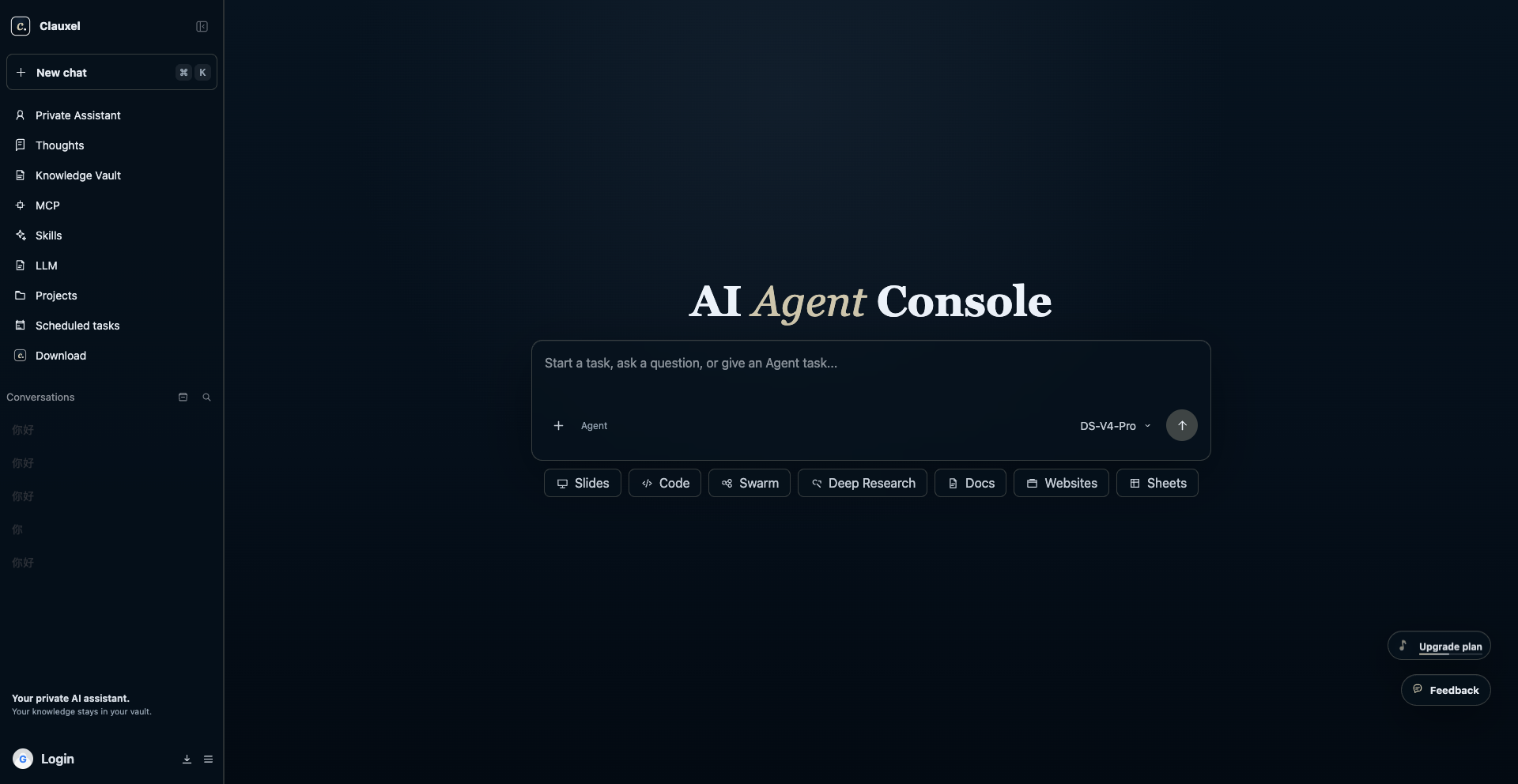
Clauxel Private Assistant console showing Philosophy, Knowledge Vault, MCP, Skills, and LLM sections for building AI agents.
Clauxel gives the agent a visible workspace: knowledge, tools, skills, model routes, and review habits stay close to the work.

The private agent stack has six layers.

Building AI agents becomes reliable when each layer answers a practical question: what job is this agent doing, what judgment should guide it, what knowledge may it use, which tools can change the world, which skills make the work repeatable, and where does a human review the trace?

01

Start with one job contract

Choose one workflow a real person already repeats: research a topic, prepare a release, review a proposal, qualify a lead, or repair a failed task. Write the success condition, inputs, forbidden actions, budget, and the point where the assistant must stop and ask.

02

Give the agent a philosophy

A private assistant needs judgment rules, not only instructions. Define what careful work means, how to handle uncertainty, which tradeoffs are acceptable, and when safety, privacy, money, or public reputation require human ownership.

03

Build the knowledge layer

Move trusted notes, documents, examples, decisions, and source material into a private knowledge space. The agent should retrieve and cite what you gave it, record useful decisions, and avoid guessing from stale memory.

04

Add MCP tools deliberately

Give the assistant tools only after the job boundary is clear. Each tool needs a readable name, a narrow schema, visible invocation, expected output, retry rule, and confirmation point for actions that change external state.

05

Package repeatable skills

Turn good work into procedures: research, compare, write, deploy, verify, recover, and hand off. A skill should carry the checklist, scripts, examples, and failure notes that keep the next run from starting over.

06

Route models and review

Use a stronger model for planning and review, a faster route for routine execution, and a checkpoint before public, paid, destructive, identity, security, or irreversible actions. The agent is useful when the trace is reviewable.
Map the workflow before giving the agent more freedom.

A useful agent is not measured by how autonomous it sounds. It is measured by whether the right work happens, the right tools run, and the right person can inspect the result before risk compounds.

Workflow Start with Define clearly Human checkpoint
Source-backed researchKnowledge plus web/source toolsQuestion, source quality bar, citation style, freshness windowBefore publishing conclusions or using weak sources
Workspace changesFiles, shell, tests, and diff reviewTarget files, safe commands, test gate, rollback pathBefore deleting, committing, deploying, or touching secrets
Customer workflowCRM, email, calendar, and approval toolsCustomer stage, allowed messages, tone, required recordsBefore sending to a person or changing an account
Browser or SaaS operationBrowser, screenshots, form state, and policy checksTarget URL, account boundary, expected screen, stop conditionsBefore payments, purchases, settings, or verification gates
Long-running projectDurable state, tasks, logs, and resumable stepsMilestones, handoff artifact, retry budget, owner checkpointAt every phase change or when evidence conflicts

First-run review loop

Make the agent prove the loop before it earns autonomy.

Teams building AI agents often skip from a promising prompt to a broad automation plan. Clauxel keeps the first version narrower: one job, one trace, one reusable skill, and one clear point where a human can approve, edit, or stop the run.

01

Run one complete case

When building AI agents, start with a single real case that includes the user request, required context, allowed tools, expected output, and known failure case. The first run should be small enough that a reviewer can inspect every choice without skimming.

02

Read the trace before adding tools

Check whether the agent chose the right information, asked when the input was incomplete, and stopped before risk. If the trace is confusing, fix the instructions and tool names before adding another connector or model route.

03

Save the reusable skill

A useful Clauxel agent should leave a procedure behind: the job card, accepted examples, rejected examples, commands or tools used, and the handoff rule. That procedure becomes the next version of the agent instead of a one-off chat transcript.

04

Raise autonomy only after repeatability

Building AI agents is safest when autonomy grows after repeated clean runs. Let the agent read, draft, compare, and prepare first; then allow limited external actions behind confirmation once evidence shows the same workflow behaves predictably.

Choose the smallest architecture that still closes the loop.

OpenAI frames agents around model, tools, and instructions. Anthropic separates structured workflows from agents that dynamically choose their own path. MCP defines a practical tool boundary, while LangChain, Cloudflare, AutoGen, and Google ADK show patterns for human review, durable state, graph control, and memory. For most teams, the first Clauxel agent should be a single visible assistant with strong procedures before it becomes a multi-agent system.

Build a private AI agent for this one job:

Goal:
Inputs:
Knowledge sources:
Allowed tools:
Forbidden actions:
Success criteria:
Stop and ask when:
Human review owner:
Evidence the agent must leave:
Skill to save after the run:

What usually breaks when people rush into autonomy.

Builder communities keep surfacing the same pattern: agents are impressive on small tasks, but complex work drifts when the mission is vague, tool calls are opaque, state is shared carelessly, or nobody reviews the trace.

The agent has a vague mission

A broad instruction such as "handle marketing" is not a build plan. Narrow the first version to one outcome, one user, and one reviewable deliverable.

Tools are powerful but undocumented

Tool names, parameters, output shapes, and side effects must be obvious. If two tools look similar, the model will eventually pick the wrong one.

Memory becomes a junk drawer

Save preferences, decisions, source summaries, and reusable procedures. Do not save every transient thought or every raw artifact as permanent context.

Autonomy hides the moment of risk

The assistant should be able to proceed on safe reading and drafting tasks, but it should pause before money, external messages, credentials, public release, deletion, or account changes.

No eval, no trace, no trust

Every real agent needs a small repeatable test: give it the same input, inspect tool calls, compare the output, and keep the trace that explains why it passed.

Building AI agents: practical questions.

Use these answers to keep the page close to the work. The goal is not to collect framework names. The goal is to ship a private assistant that can act, pause, remember, and improve without hiding risk.

What is the first step in building AI agents?

Start with one job contract. Define the task, inputs, allowed tools, success criteria, stop rules, and the human checkpoint before choosing a framework or model.

Do I need multiple agents?

Usually not at the beginning. Start with one agent, clear tools, and reviewable steps. Split into multiple agents only when the prompts, tools, or responsibilities become too tangled for one assistant to handle reliably.

Where does MCP fit?

MCP belongs at the tool boundary. It gives the agent a structured way to discover and call external capabilities, while your interface keeps those capabilities visible and permissioned.

How should memory work?

Use memory for durable preferences, decisions, source summaries, examples, and lessons. Keep it inspectable and editable so the assistant improves without carrying private clutter into every task.

How can Clauxel help?

Use Clauxel as the private assistant surface: define the job, shape the knowledge vault, connect tools, package skills, choose model routes, and keep review checkpoints close to the work.

Build the first private assistant inside Clauxel.

Start with the console, then bring in knowledge, MCP tools, skills, and model routes only as the job requires them. Keep the first trace small enough that you can inspect it end to end.