Name the decision, handoff, or deliverable the AI should improve. If the outcome is vague, the architecture will sprawl.
AI solution architecture
Building AI solution architecture starts with the decision the system must improve.
Use this guide when the question is larger than one bot or one assistant: which AI shape should solve the business workflow, who owns it, and what must be true before launch.
Use case / architecture guide
building ai solution
01Decision02Shape03Data04Tools05Launch
OwnerEvidenceRiskReviewGrowth
Pick the smallest system shape that changes the outcome.
Building AI solution architecture should begin with the business decision, not the model brand. Decide whether the job needs a bot, assistant, pipeline, agent, or simple automation. Then define data ownership, tool permissions, review gates, launch evidence, and the operating plan. An AI solution can be a scripted bot, a grounded assistant, a repeatable pipeline, a tool-using agent, or plain deterministic automation. The right shape depends on the decision it improves.
Choose bot, assistant, pipeline, agent, or deterministic automation based on memory, tool use, and review needs.
Assign the business owner, data owner, reviewer, and operator before the first launch.
Define the examples, traces, failure cases, and metrics that prove the solution is worth scaling.
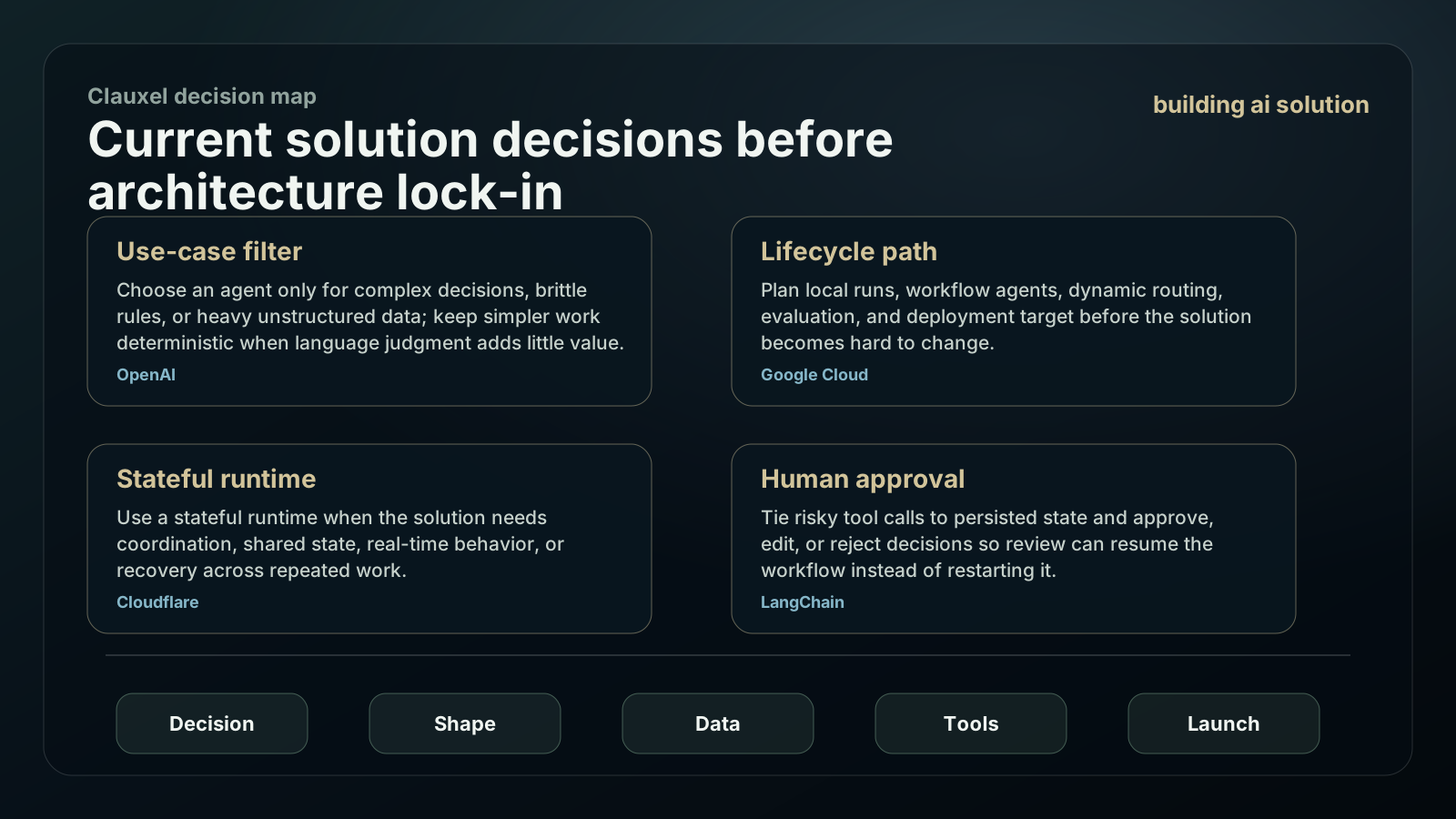
Current solution decisions before architecture lock-in
A serious AI solution should decide runtime, state, model route, tool exposure, evaluation, deployment, and owner review before model branding becomes the conversation.
Choose an agent only for complex decisions, brittle rules, or heavy unstructured data; keep simpler work deterministic when language judgment adds little value.
Plan local runs, workflow agents, dynamic routing, evaluation, and deployment target before the solution becomes hard to change.
Use a stateful runtime when the solution needs coordination, shared state, real-time behavior, or recovery across repeated work.
Tie risky tool calls to persisted state and approve, edit, or reject decisions so review can resume the workflow instead of restarting it.
Turn the solution idea into an operating plan.
A strong solution plan explains not only what to build, but how the system will be owned, reviewed, measured, and repaired.
Write the decision statement
Define the before-and-after: what decision is slow, expensive, risky, or inconsistent today, and what better result should look like.
Choose the system shape
Use a bot for front-door conversation, assistant for repeatable private help, pipeline for staged artifacts, and agent for tool-using execution.
Map the data boundary
List the sources, freshness needs, retention rule, private material, and data that should never enter the AI path.
Define tool risk
Separate read, draft, action, account, payment, deployment, and deletion capabilities. Put risky actions behind approval.
Create launch evidence
Prepare representative examples, acceptance criteria, review traces, fallback behavior, and unresolved blockers.
Plan iteration windows
After launch, review usage, rejected outputs, handoffs, source gaps, conversion events, and the pages or workflows that need tightening.
Architecture decision board
Use this board to prevent a solution plan from turning every workflow into the same agent pitch.
| Problem shape | Best first system | Evidence to require | Do not build yet if |
|---|---|---|---|
| Routine question answering | Scripted bot or grounded assistant | Top questions, approved answers, source freshness | Policy facts are still changing daily. |
| Repeated personal work | Private assistant | Role card, trusted knowledge, memory receipt, five examples | The user cannot name the repeated job. |
| Staged artifact production | AI pipeline | Input packet, run graph, review checkpoint, trace | The final artifact is not defined. |
| Open-ended tool execution | Agent workflow | Tool schemas, eval cases, stop rule, human approval | Actions are powerful but hard to inspect. |
| Stable transformation | Deterministic automation plus optional AI review | Rules, test cases, exception handling | Language judgment adds no measurable value. |
Solution ownership map
Building AI solution work fails when ownership is vague. Put names or roles next to every moving part before launch.
Copy the solution brief
Build an AI solution:

Business decision to improve:
User or team:
Current workflow:
Best first system shape:
Data sources:
Data never allowed:
Tools allowed:
Approval rules:
Launch examples:
Success metric:
Owner and reviewer:
Iteration window:
| Permission area | Allowed first | Keep out until review |
|---|---|---|
| Business owner | Owns the workflow outcome and decides whether the solution is worth keeping. | Do not let the implementation team invent success after launch. |
| Data owner | Controls source access, retention, privacy, and freshness decisions. | Do not mix sensitive sources into demos without approval. |
| Tool owner | Reviews schemas, side effects, retries, and failure handling. | Do not ship broad tools without logs and approval rules. |
| Reviewer | Approves examples, traces, refusal behavior, and risky actions. | Do not treat one demo as acceptance. |
| Operator | Watches analytics, failures, handoffs, cost, and iteration backlog. | Do not launch a system nobody can repair. |
Solution risks that appear after the demo.
The demo usually proves possibility. The solution plan must prove ownership, safety, measurement, and repair.
A solution that tries to be bot, assistant, pipeline, and agent on day one becomes hard to explain.
Unclear source boundaries create privacy risk and weak answers.
If nobody watches failures and handoffs, the solution decays after launch.
A solution can look impressive while failing to improve the decision it was meant to help.
What to keep out of the first AI solution
The first release should be small enough to review completely. Save broad autonomy and extra channels for later evidence.
Avoid multi-agent designs unless separate roles, tools, and tests are already clear.
Avoid account-changing or paid actions until approval and audit paths are working.
Avoid hiding source quality, model limitations, or privacy boundaries behind polished UI.
Avoid measuring only usage. Track handoffs, rejected outputs, source gaps, and improved decisions.
Solution review signals after the first operating window
The first operating window should prove that the solution improves the named decision and has an owner who can repair it when reality changes.
Compare the workflow decision before and after launch. Usage is secondary if the decision is not faster, clearer, or safer.
Check whether the business owner, data owner, tool owner, reviewer, and operator actually touched the evidence they own.
List stale, missing, conflicting, or overly broad data sources. Data boundary work often creates the next release plan.
Measure how quickly the team can identify a failed run, understand the trace, and choose whether to edit data, tool rules, or system shape.
Building AI Solution: Architecture Guide FAQ
Use these answers to decide the first build shape, then bring the idea back into Coachix for the role, tools, sources, and review trace.
What is the first step in building AI solution plans?
Write the decision statement: which workflow decision should improve, for whom, and what better output looks like.
How do I choose between bot, assistant, pipeline, and agent?
Match the system shape to the job: bot for front-door conversation, assistant for repeatable private help, pipeline for staged artifacts, agent for tool-using execution.
What evidence should an AI solution have before launch?
Use representative examples, expected outputs, failure cases, tool traces, review notes, and a named owner for iteration.
How does Coachix help build an AI solution?
Coachix keeps the decision brief, knowledge, tools, model routes, review traces, and launch notes in one private workspace.
Continue the Coachix build path.
Move between assistant, bot, pipeline, solution, prototype, and agent pages without losing the private workspace boundary.