Quick answer
Answer the LTX 2.5 vs MiniMax H3 choice before spending credits.
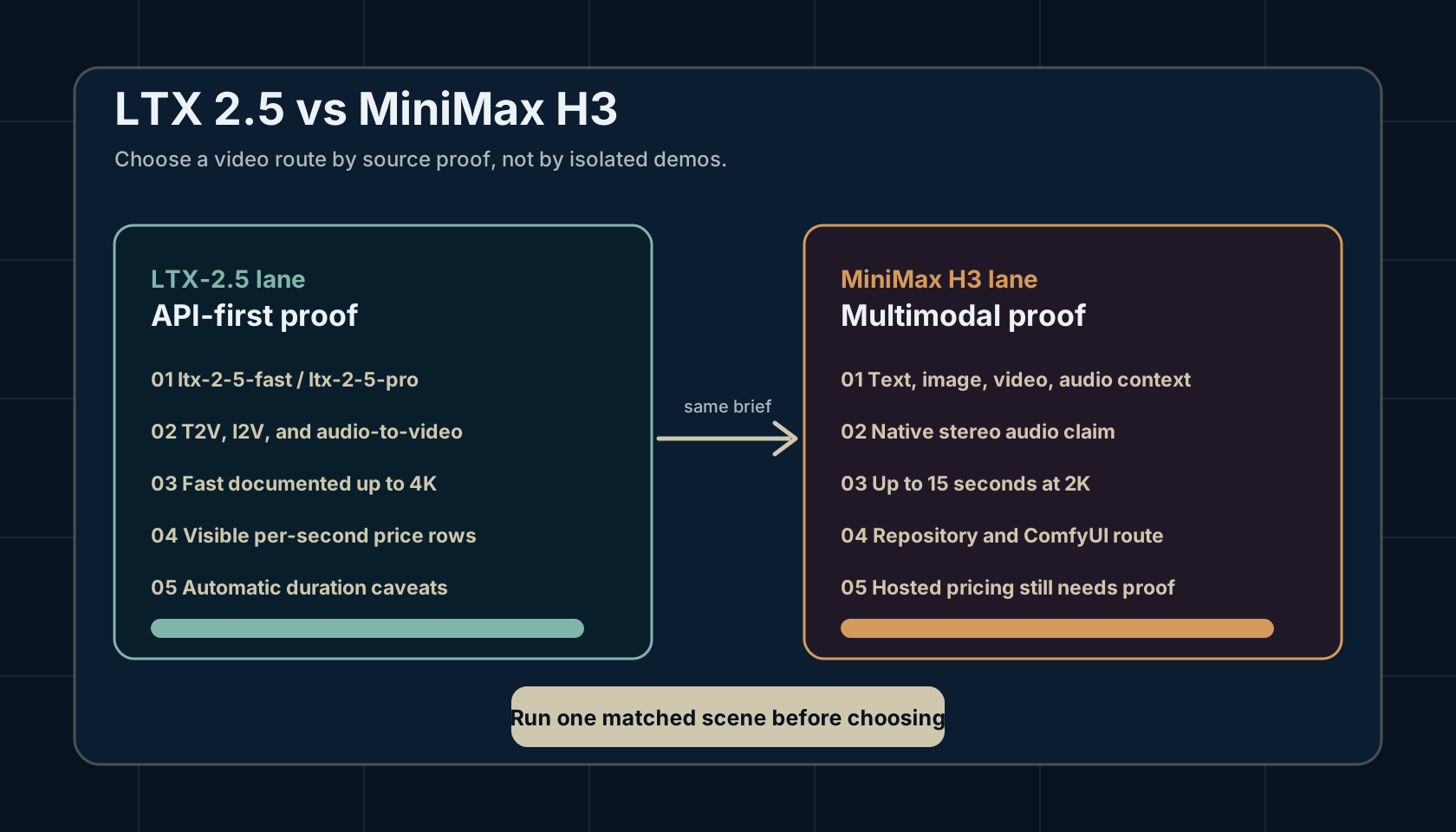
Use LTX-2.5 first when the job needs a documented API route, visible per-second pricing, text-to-video, image-to-video, audio-to-video, or a Fast variant that LTX documents up to 4K. Use MiniMax H3 first when the job depends on a multimodal creative model with text, images, video, and audio as unified context, native stereo audio, and up to 15-second video at 2K, then verify the exact open-weight or hosted workflow before production.
The practical ltx 2.5 vs minimax h3 answer is not a universal winner. It is a route decision. Keep LTX-2.5 pricing and endpoint proof separate from MiniMax H3 release claims, ComfyUI files, and any Hailuo API billing surface. Coachix should record one prompt, one reference pack, one expected clip, one cost check, one rights note, and one fallback before credits are spent.
Reader fit
Answer the LTX 2.5 vs MiniMax H3 choice before spending credits.
Visitors need a direct comparison that separates API availability, pricing, output claims, open-weight workflow proof, rights review, and the first fair test.
| What is the shortest answer? | Use LTX-2.5 when a documented API, visible per-second pricing, and output ceilings matter most. Use MiniMax H3 when multimodal references, native sound, and open-weight or ComfyUI planning matter most. LTX API Docs LTX API Docs MiniMax ComfyUI Docs |
|---|---|
| Which LTX route is real? | LTX docs list ltx-2-5-fast and ltx-2-5-pro with text-to-video, image-to-video, and audio-to-video support. Fast reaches a documented 4K ceiling while Pro tops out at 1080p. LTX API Docs |
| What does MiniMax H3 prove officially? | MiniMax says H3 understands text, images, video, and audio as unified context and generates video with native stereo sound up to 15 seconds at 2K. MiniMax |
| What costs are visible? | LTX-2.5 has public per-second pricing rows. MiniMax API and video package pages need route-specific proof before anyone treats H3 hosted pricing as known. LTX API Docs MiniMax API Platform MiniMax API Docs |
| What route is local or open-weight? | MiniMax-H3 and ComfyUI docs give an open-weight workflow path to inspect. LTX-2.5 also has a gated upstream model-card surface that needs license and access review. MiniMax-AI / GitHub ComfyUI Docs Lightricks on Hugging Face |
| What should Coachix prepare? | Coachix should hold the same scene brief, asset list, model IDs, cost estimate, review rubric, rights note, and fallback so the comparison is fair. Hugging Face Community Reddit search and web search |
| What can break the decision? | Mixing Hailuo pricing into H3, confusing LTX-2.5 with deprecated LTX 2 IDs, or testing different prompts will make the comparison unreliable. LTX API Docs MiniMax API Docs Google Search |
- Pin exact routes before testing.
- Keep API proof and open-weight proof separate.
- Use one matched scene before choosing a winner.
Checked facts
Facts to verify before adoption.
Use these rows to separate official signals, upstream cards, event reports, and community friction.
| LTX-2.5 API route | LTX docs list ltx-2-5-fast and ltx-2-5-pro. Both support text-to-video, image-to-video, and audio-to-video; Fast is documented up to 4K and Pro up to 1080p. LTX API Docs |
|---|---|
| LTX-2.5 pricing proof | LTX pricing lists ltx-2-5-fast at $0.09, $0.13, $0.19, and $0.30 per second for 720p, 1080p, 1440p, and 4K, and ltx-2-5-pro at $0.12 and $0.17 per second for 720p and 1080p. LTX API Docs |
| LTX-2.5 model-card proof | The Lightricks/LTX-2.5 Hugging Face page exists, is gated, carries LTX-2 community license metadata, and is tagged for image, text, video, and audio generation modes. Lightricks on Hugging Face |
| MiniMax H3 official route | MiniMax published H3 as a general-purpose multimodal generation model that understands text, images, video, and audio as unified context and generates video with native stereo sound up to 15 seconds at 2K. MiniMax |
| MiniMax H3 open-weight route | MiniMax-H3 and ComfyUI sources provide an open-weight workflow path, while the public MiniMax API docs checked for this build still need account-level proof before H3 billing or hosted model IDs are assumed. MiniMax-AI / GitHub ComfyUI Docs MiniMax API Docs MiniMax API Platform |
| Comparison verdict | Pick LTX-2.5 when visible API price, automatic duration, and explicit output ceilings matter most. Pick MiniMax H3 when multimodal references, native sound, open-weight workflow planning, or ComfyUI tests matter most. LTX API Docs LTX API Docs MiniMax ComfyUI Docs |
Evaluation worksheet
Write the adoption note before the first serious run.
For this LTX 2.5 vs MiniMax H3 route, define the input, expected output, failure condition, reviewer, manual stop, and next action before the first run. Judge results against that note, not surface polish.
Decision helper
Choose the first comparison check
API and pricing proof
Start here when output will be generated through an API. Compare ltx-2-5-fast or ltx-2-5-pro pricing and endpoints against the visible MiniMax H3 model ID and billing surface before credits are spent.
Safe sequence
Move from interest to a reviewable trace.
- 01
Define one video job with target duration, resolution, audio need, references, review owner, and pass/fail criteria.
- 02
Pin the exact LTX route and MiniMax H3 route that are actually available in the account, repository, or ComfyUI environment.
- 03
Run the smallest comparable scene and record cost, artifacts, prompt changes, output settings, and reviewer notes.
- 04
Choose proceed, retry, fallback, or blocked only after API proof, open-weight proof, rights, and fallback are all visible.
Field guide
Compare routes by evidence, not model drama.
LTX-2.5 and MiniMax H3 answer different buyer anxieties. LTX-2.5 has the clearer public API contract in this check: named Fast and Pro IDs, endpoint support, visible per-second pricing, and documented output ceilings. That makes it easier to budget a controlled API run before creative arguments start.
MiniMax H3 answers a different question: whether a broad multimodal generator can use text, image, video, and audio context to produce a richer video route with native sound. The launch page gives strong creative claims, and the public repository plus ComfyUI docs give a practical open-weight path to inspect.
The trap is mixing surfaces. Hailuo API docs and pricing can be useful MiniMax context, but they are not automatic proof of H3 hosted pricing. LTX-2 and LTX-2.3 facts can explain migration, but they should not be pasted into an LTX-2.5 comparison without naming the model ID.
A good comparison page should end with a prepared test. Coachix should hold the prompt, route IDs, asset list, review rubric, cost estimate, rights note, and fallback so the team can compare the same job rather than arguing from isolated demos.
- Separate API proof, open-weight proof, and release claims before comparing outputs.
- Do not transfer Hailuo pricing or older LTX-2 behavior into the H3 or LTX-2.5 verdict.
- Judge one matching scene with a saved rubric before choosing a default video route.
Copyable handoff
Copyable prompt for an LTX 2.5 vs MiniMax H3 route
Compare LTX-2.5 and MiniMax H3 for one video workflow. Use only the supplied current sources. Identify the available API or local route, exact model ID, input types, audio needs, duration and resolution target, price evidence, license or rights boundary, first prompt, review rubric, fallback model, and blocked unknowns. Return proceed, retry, fallback, or blocked. Do not invent MiniMax H3 API pricing, hosted model IDs, benchmark wins, or LTX-2.5 capabilities that are not in the current docs.
- Do not call the comparison won until the same brief, assets, duration, and review rubric have been tested.
- Do not treat MiniMax Hailuo API pricing as MiniMax H3 pricing unless the current account or docs show that mapping.
- Do not confuse LTX-2.5 with deprecated ltx-2-fast, ltx-2-pro, or older LTX-2.3 routes.
- Do not move real brand, client, or paid campaign assets into the first test without a rights review.
FAQ
LTX 2.5 vs MiniMax H3 questions builders should answer.
What is the short ltx 2.5 vs minimax h3 answer?
Use LTX-2.5 first for a documented API route with visible pricing and output ceilings. Use MiniMax H3 first for multimodal reference-heavy video work, native sound, and open-weight or ComfyUI planning.
Is LTX-2.5 available as an API model?
Yes. LTX docs list ltx-2-5-fast and ltx-2-5-pro with text-to-video, image-to-video, and audio-to-video support. Verify account availability before production.
Does MiniMax H3 have public API pricing?
The checked MiniMax API docs and pricing surfaces still need route-specific proof for H3. Keep Hailuo API pricing as context, not as H3 billing proof.
Which model is better for 4K output?
LTX docs list ltx-2-5-fast up to 4K. MiniMax H3 launch material describes video up to 15 seconds at 2K, so choose based on the actual route and required resolution.
Which model should I test in ComfyUI?
Use the MiniMax H3 in ComfyUI route when local workflow, model files, T2V, I2V, or R2V setup are the main decision. Compare with LTX only after hardware and rights are clear.
Related Coachix pages