01 / MODEL
What is Jev?
Jev is TypeSafe AI’s first System One Model: a model for making bounded decisions inside software. Supply text and a set of questions; receive typed choices, scores or probabilities that ordinary code can use. It does not produce arbitrary prose, code or explanations. The launch article is dated September 15, 2026.
Its useful distinction is a programmable decision interface. A conventional classifier often has a fixed label set. Jev accepts descriptions of possible answers at request time, so the same hosted model can classify a support ticket, judge relevance or select a candidate action without customer-specific training.
TypeSafe describes a new architecture, a parallel sampler and Reinforcement Learning for Calibrated Decisions (RLCD). These describe its direction; the public material does not disclose enough architecture or training detail to reproduce Jev.
Official launch · Introduction · TypeSafe AI
The team and the idea behind the model
CEO Diogo Almeida is a coauthor of the InstructGPT paper. TypeSafe’s team page also lists COO Sasha Sheng, previously at Meta FAIR, and CTO Erik Gafni. That is useful background, rather than evidence of Jev’s performance. The company’s Composable AI manifesto argues for putting semantic judgment inside code that retains control over the larger workflow.
02 / INTERFACE
One state. Three kinds of question.
A request contains state and questions. Independent questions can be evaluated against the same state in parallel. If one question needs another answer, make a later call; parallel questions do not exchange answers with each other.
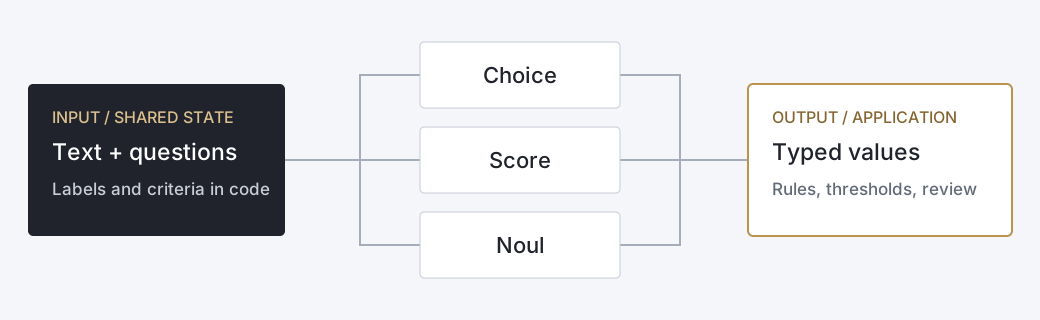
| Primitive | Returned value | Constraints and use |
|---|---|---|
| Choice | A selected option, a probability for each option and a confidence field. | Up to 255 options. Suitable for routing, intent labels and choosing candidates. Include an “other” or “none” option when the list may not cover the input. |
| Score | A distribution over ordered levels and the probability-weighted mean of their indices. | 2–10 textual criteria. Useful for relevance or severity. This is an ordinal score, not exact numerical regression. |
| Noul | P(yes), a number between 0 and 1. | Truth of a proposition. No separate confidence field. A value of 0.5 means uncertainty about yes/no, not medium intensity. |
For Score, indices run from 0 to k−1. A distribution with 70% on level 1 and 30% on level 2 gives 1.3. Each level should describe a meaningful standard on its own, rather than referring vaguely to a neighboring level.
Question-map keys are identifiers, not a place to hide instructions: Choice documentation says the model does not see that key. Put the task in the instructions and the meaning of each choice in its visible label or description. Structured JSON state and richer descriptions are supported.
Advanced primitives · Building with System One
Extract by selecting, then copying
The extraction cookbook first uses regex, named-entity recognition or another model to propose spans. Jev selects among those candidates; code copies the original value. This reduces opportunities to invent a field value, but the candidate generator sets the recall ceiling: a missing candidate cannot be recovered by choosing from the list.
03 / UNCERTAINTY
Type safety, accuracy and calibration are different.
Type safety
Can the application read the answer as the promised type or enum?
Accuracy
Did the model choose the right answer for this task?
Calibration
Across comparable predictions, do estimated probabilities match observed outcome rates?
A legal enum can still be the wrong choice. A model that predicts 80% should, on comparable examples, be right about 80% of the time. That is a population-level property, not a guarantee about one response. It must be measured on the distribution the application will actually encounter.
The confidence field is a statistic derived from the output distribution. It is not an independently elicited explanation and should not be equated automatically with the probability that the selected answer is correct. A concentrated distribution can still be confidently wrong. Noul’s zero means a strong “no,” not zero confidence.
Confidence reference · Calibration and training primer
Questions are not guaranteed to form one globally consistent probability system. The official limitations page gives related refund judgments with probabilities 0.72 and 0.47, and shows a Noul formulation and a binary Choice formulation producing different values. Do not combine separate answers as though they were a coherent joint distribution.
04 / SPECS & ACCESS
Jev 1.13.0 at a glance
Public specifications as of September 19, 2026. Model aliases, limits and prices can change.
- Model
jev-1.13.0;jev-latestandjev-previewcurrently resolve to it.- Input
- Text, including strings, JSON objects and arrays of text values. No native image, audio or video input.
- Context
- 64k tokens across state and all questions; 32k for state plus the longest individual question.
- Input price
- $0.042 per million tokens. Output is free. Questions and criteria count as input.
- Documented limits
- 250,000 tokens per second and 1,200 requests per minute, subject to dynamic limits.
- Language
- English is the primary strength. Other languages, including CJK, have uneven performance.
- Customization
- Shared model weights across accounts; no customer fine-tuning or LoRA offering is documented.
- Native endpoint
POST https://api.typesafe.ai/v1/systemone; model discovery atGET /v1/models.
Where to access it
- TypeSafe AI offers the direct service; its homepage displays early-access registration.
- OpenRouter’s Jev 1.13 listing is dated September 18 and lists 32K context at the same input price. That platform date is not the original launch date. Its context listing should not be confused with the native API’s total multi-question allowance. See also the latest alias.
- Cloudflare’s Jev documentation lists
typesafe/jev, typed evaluation examples and a 32,000-token context window. It links to dashboard pricing; do not assume every access provider has identical commercial terms.
These are model-access and documentation destinations, not a promise that an existing Coachix account includes Jev. This guide does not expose an inference endpoint or ask for an API key.
05 / COST
What the token price means in practice
| Billable input per request | Cost per request | One million requests |
|---|---|---|
| 1,000 tokens | $0.000042 | $42 |
| 10,000 tokens | $0.00042 | $420 |
These are arithmetic examples using the published direct input price. They exclude preprocessing, storage, retries, network infrastructure and fallback models. Parallel questions can share state, but their instructions and criteria still consume tokens.
The parallel-questions cookbook reports 13 judgments on one GDPR document in a single request, about 12.2 times cheaper and 10 times faster than separate calls. That example uses Jev 1.12; it is evidence for batching that workload, not a universal Jev 1.13 multiplier.
06 / OFFICIAL BENCHMARKS
Low cost and latency, with a quality trade-off
TypeSafe’s workflow evaluation covers security incidents, agent-trace observability, invoice processing and customer service. It uses reference probabilities from GPT-6 Astra and Claude Fable 5.1 at high reasoning settings. Other models generally use provider defaults. Scores measure agreement with that reference, not independently human-labeled business truth.
| Model / workflow | Score | Cost per case | Latency |
|---|---|---|---|
| Jev | 67.8% | $0.0004 | 0.4 s |
| terra | 67.9% | $0.0304 | 10.1 s |
| sol | 74.1% | $0.0836 | 23.3 s |
| sonnet 5 | 67.8% | $0.1174 | 78.1 s |
| opus 5 | 73.1% | $0.1761 | 37.8 s |
| haiku 4.5 | 53.6% | $0.0195 | 12.5 s |
| DeepSeek V4 Flash | 64.4% | $0.0059 | 51.9 s |
| DeepSeek V4 Pro | 65.5% | $0.0413 | 86.5 s |
| luna | 66.8% | $0.0033 | 12.9 s |
Official workflow evaluation and charts. Values are rounded chart labels; the four workflows have equal weight.
Jev occupies a useful low-cost, low-latency position, but sol and opus 5 score higher. Agreement also varies by workflow:
| Jev workflow | Score | Cost per case | Latency |
|---|---|---|---|
| Security incidents | 61.7% | $0.0001 | 0.3 s |
| Agent traces | 71.6% | $0.0003 | 0.5 s |
| Invoice processing | 61.8% | $0.0011 | 0.5 s |
| Customer service | 76.0% | $0.0001 | 0.4 s |
Invoice workflow · Customer-service workflow
These evaluations assume a correct workflow implemented in code. Invoice arithmetic belongs to that code, rather than proving exact numerical reasoning inside Jev. Comparing a model within a workflow to a model asked to reason through the whole task also measures the surrounding design.
TypeSafe’s headline 193.6× speed and 444.6× cost improvements come from particular workflows. Its LLM adapter requests complete probability distributions, which costs more than a label-only answer. Short inputs and nearby US West Coast clients also favor the demonstration setup.
07 / INDEPENDENT TESTS
Calibration changes with the task.
ASSAY-001: two intent-classification datasets
JourdanLabs published its protocol, requests, responses and scoring code. ECE below is calibration error over ten bins of chosen-option probabilities; it is not the model’s error rate or its separate confidence field.
| Dataset | n | Accuracy | ECE ↓ | Median / p95 |
|---|---|---|---|---|
| Banking77 | 3,080 | 79.77% | 0.0936 | 382 / 554 ms |
| CLINC150 + OOS | 5,496 | 88.12% | 0.0204 | 386 / 615 ms |
One dataset passed the authors’ ECE ≤ 0.05 criterion; the other did not. Their zero-schema-violation result uses a post-run probability-sum tolerance amendment from 0.001 to 0.02: 513 rounded sums failed the original rule. Three selected answers also differed from argmax within 0.01 of a tie. Public, older datasets leave training contamination unresolved. These results concern Choice on this run, not every primitive or domain.
ASSAY-001 report and disclosed amendments · Raw artifacts and scoring code
A 300-example comparison with GLiNER2.5
AbdelStark’s pilot used 100 held-out examples per condition, fixed revisions and identical label descriptions. Banking77/BTZSC here has 72 labels, so it is not the same setup as the 77-label study above.
| Condition | Jev accuracy | GLiNER2.5 | Interpretation |
|---|---|---|---|
| AG News · 4 labels | 91% | 70% | Clear advantage in this sample |
| Banking77/BTZSC · 72 | 87% | 61% | Clear advantage in this sample |
| DAIR Emotion · 6 | 48% | 44% | Difference interval includes zero |
On emotion, Jev had worse Brier score (0.846 versus 0.668) and NLL (5.588 versus 1.381), assigning zero probability to the true label on 16% of samples. Local GLiNER on an M4 Max CPU took roughly 44 ms on small-label tasks, versus 236–256 ms for hosted Jev from France. With 72 labels, Jev took 246 ms versus 296 ms. Deployment and network differences matter.
Pilot report, protocol and metrics. These are published community results, not Coachix-run inference tests.
08 / DEMONSTRATIONS
What the demos actually show
- Doom: the model reads structured text state, not pixels. The team reports ten calls per second at about $7 an hour and acknowledges that a conventional bot could play better.
- Wikiracing: choices above 255 use scoring followed by selection. Comparisons mostly disable LLM reasoning, so they do not establish a general reasoning advantage.
Official demonstrations and their limitations
In Every’s first-hand trial, Mike Taylor reports 777 judgments across 37 documents in under 0.7 seconds, at about $0.0025. The broader article describes 1,709 judgments over eleven experiments for under a cent. This demonstrates a promising batch-review workflow, but subjective inspection without complete human ground truth is not a benchmark of accuracy.
09 / PAPERS
Is there a Jev research paper?
No public Jev architecture or TypeSafe RLCD training paper was located as of September 19, 2026. In the launch discussion, the founder says the architecture remains private and that the team has discussed writing a paper. No reliable parameter count, training-data recipe, compute budget, backbone or ablation suite is available in the material cited here.
Hacker News launch discussion and founder responses
The following papers explain related ideas. None should be labeled “the Jev paper.”
On Calibration of Modern Neural Networks
Foundational work on the gap between classification accuracy and reliable probabilities, including temperature scaling. Useful for understanding what a calibration claim must measure.
Language Models (Mostly) Know What They Know
Studies estimates of answer correctness and model knowledge. Some formats produce useful probability estimates, while transfer remains difficult. Uncertainty estimation is not unique to Jev.
Beyond Binary Rewards: Training LMs to Reason About Their Uncertainty
Introduces RLCR, reinforcement learning with calibration rewards, combining correctness with a Brier-based penalty. It addresses a related objective in reasoning language models; it does not reveal TypeSafe’s RLCD. Author project page.
Training language models to follow instructions with human feedback
The InstructGPT paper connects supervised fine-tuning, human preferences and reinforcement learning. Almeida is a coauthor. It establishes research background, not Jev’s architecture.
RLCD: Reinforcement Learning from Contrastive Distillation for Language Model Alignment
A naming collision: this RLCD generates preference data through contrastive prompting. TypeSafe expands the same initials as “Reinforcement Learning for Calibrated Decisions.” They are different methods. Original code.
Large Language Diffusion Models
Background for diffusion-model discussions, not confirmed Jev lineage. A LLaDA fork in TypeSafe’s GitHub organization is insufficient evidence that Jev uses LLaDA, masked diffusion or any particular backbone.
10 / BLOGS & READING
Read the original arguments.
Introducing System One Models and Jev
The launch, product interface, performance claims and accompanying caveats.
Composable AI: Build Prod, Not God
The case for software-controlled workflows made from narrow model judgments.
The Bitterest Lesson
Argues that choosing the right task matters before optimizing data, compute or algorithms. This is product philosophy, not experimental validation.
Lies, Damned Lies, and Benchmarks
A critique of benchmark optimization and a case for dated, task-specific evidence. The argument does not remove the need for independent evaluation.
Mini Vibe Check: TypeSafe’s Jev Judged Everything I’ve Written in 0.7 Seconds
A first-hand writing-evaluation experiment with published timing and cost observations.
AI: Too good to be true, too bad to be useful
A prelaunch video-blog entry. No transcript is cited here, so it is a viewing destination rather than support for undisclosed technical details.
11 / COMMUNITY DISCUSSION
What Hacker News is debating
The Hacker News announcement discussion centers on four useful questions: how much is new beyond dynamic zero-shot classification; whether schema guarantees are being mistaken for semantic correctness; whether probability-producing LLM comparisons are fair; and how much architecture novelty can be assessed without a paper.
A bounded interpretation holds up better than either extreme. The runtime-configurable interface and reported economics are tangible. The degree of architectural novelty remains unresolved. A strong generative model can help design and revise a workflow, while Jev handles frequent, narrow decisions within it.
The typed-decision discussion adds context about non-generative behavior. The OpenJev discussion concerns an independent interface implementation. Neither discussion establishes a disclosed training recipe for Jev.
12 / CODE, DATA & TERMS
SDKs are public. Jev weights are not.
- Official Python SDKNative TypeSafe integration.
- Official JavaScript SDKJavaScript and TypeScript integration.
- System One adapterA shared interface for comparisons, including discrete or probability answers, validation and retries.
- TypeSafe GitHub organizationOfficial repositories; no released Jev weights or full training implementation was found.
- SemIf, formerly OpenJevIndependent and unaffiliated. Implements a similar interface using open models, rather than reproducing Jev’s undisclosed model.
A community model name containing “RLCD” is also not proof of that training. For example, the LFM2.5-2.6B-RLCD model card describes an inference-only setup with unchanged weights and no reinforcement-learning training. Read the implementation claim, not just the name.
TypeSafe’s public agreement says customer data is not used to modify model weights without prior consent. That does not mean all requests have zero retention; enterprise zero-data-retention terms are a separate consideration. The agreement also restricts distillation or competing-product development using the service and publication of service benchmarks or performance information.
Master Customer Agreement, August 27, 2026, sections 2.3 and 4 · Model and data-use documentation. Public SDK availability does not establish unrestricted model rights.
13 / FIT & LIMITS
Where Jev belongs in an agent stack
A sensible candidate
- High-volume text classification and support routing.
- Scoring candidate documents or responses against clear criteria.
- Repeated independent judgments over shared state.
- Agent-trace labeling and workflow entry screening.
- Systems that can route uncertain cases to a stronger model or a person.
Keep elsewhere
- Open-ended writing, code generation and explanations.
- Exact arithmetic, counting and date calculations.
- Complex multi-hop planning and dependent reasoning.
- Image, audio or video understanding.
- Security decisions that assume the model cannot be manipulated.
The official jaggedness document lists literal interpretation, numerical precision, indirection, conflicting criteria, irrelevant context and adversarial input among the weak spots. Parallel question isolation does not make long state immune to context degradation. Prompt injection can still alter decisions.
Official limitations, reviewed September 17
For a concrete adoption decision, compare Jev, the current system and a lightweight classifier on the same representative labeled examples. Measure how many cases can be accepted at the allowed error rate, as well as p95 latency, complete cost and threshold stability on held-out data. Pin the model version when thresholds matter. Test Chinese or another target language directly.
Still missing are public evidence for the architecture and parameter count, RLCD ablations, training scale, broad out-of-domain calibration, systematic Chinese evaluation, adversarial robustness and how updates affect established thresholds. The present case is strongest for inexpensive semantic decisions, rather than universal model superiority.
14 / QUICK ANSWERS
Common questions about Jev
Is Jev a chatbot or a coding model?
No. Its public interface returns typed decisions about supplied text. Use a generative model when the result must be prose, code or an explanation.
Does “no hallucinations” mean every answer is right?
No. The schema constrains what it can return. Selecting a valid but incorrect option remains possible. Type safety does not establish factual accuracy.
Is the Jev architecture open source?
No official weights or reproducible architecture and training paper were found as of September 19, 2026. Public SDKs and unaffiliated interface projects are different artifacts.
Is the 2023 RLCD paper the paper behind Jev?
No. That paper concerns contrastive distillation. TypeSafe uses RLCD to mean reinforcement learning for calibrated decisions.
Is its context window 32k or 64k?
The direct documentation allows 64k tokens across the complete state and all questions, while state plus the longest single question is limited to 32k. Platform listings may show the 32k figure.
Can Jev replace every classification call?
That depends on the task, required accuracy and deployment. Early independent tests show both strong results and weak calibration; local lightweight classifiers can be faster on small label sets.