DeepSeek V4 Flash field note

DeepSeek V4 Flash: the worker model to test first

I would try Flash on issue triage, extraction, cleanup, and log summaries before giving it any messy planning job.

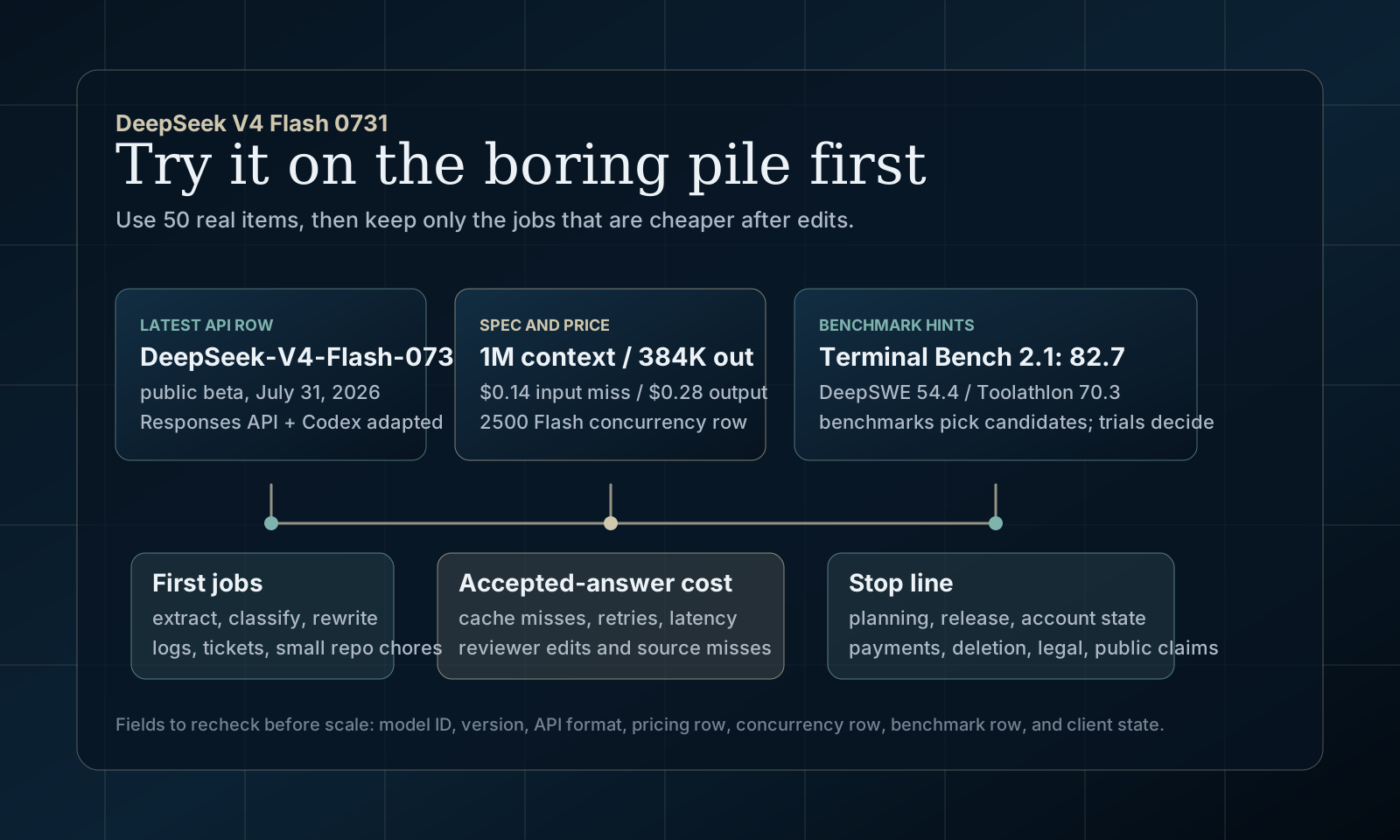
DeepSeek V4 Flash 0731 trial map showing current API facts, pricing, sample jobs, accepted-answer cost, and stop lines
Model IDdeepseek-v4-flash
Current rowDeepSeek-V4-Flash-0731
Native APIResponses API
CheckedAugust 3, 2026
0731 trial mapdocs checked
DeepSeek V4 Flash 0731 trial map showing current API facts, pricing, sample jobs, accepted-answer cost, and stop lines
0731 API row 50 real samples accepted-answer cost stop line
The image keeps the useful rows visible: what to call, what it costs, where to test first, and when to stop.

My take after reading the 0731 docs

Flash looks useful when the job is boring, repeatable, and easy to sample.

As of August 3, 2026, I would treat DeepSeek V4 Flash as a cheap worker to test, not as the main brain of an agent. The official rows are strong enough to justify a real trial: model ID deepseek-v4-flash, current version DeepSeek-V4-Flash-0731, 1M context, 384K maximum output, JSON output, tool calls, OpenAI ChatCompletions format, Anthropic API compatibility, and Responses API support.

The number that catches my eye is not the tiny cache-hit price. It is the cache-miss and output pair: $0.14 input and $0.28 output per 1M tokens, with a listed 2500 Flash concurrency limit. That is cheap enough for queue work, but it can still lose if retries, latency, or reviewer edits pile up.

My first trial would be 50 real items: support tickets, logs, extraction jobs, rewrite jobs, and a few tool traces from the actual client. I would record accepted outputs, reviewer edits, retries, latency, cache behavior, and every place the client drops state.

If Flash passes that trial, keep it on the boring pile. If it guesses missing fields, drifts after a tool result, or makes the reviewer reread the whole input, move planning and final judgment back to V4 Pro, Claude, or a person.

Facts I would recheck before using it

Keep these rows next to the first test script. They are the details most likely to bite when someone swaps the model name and calls the migration done.

Model ID Use deepseek-v4-flash when calling the API path documented by DeepSeek. DeepSeek API Docs
Current status The July 31, 2026 changelog says the official DeepSeek-V4-Flash API release is in public beta. DeepSeek API Docs
Current version The pricing table lists DeepSeek-V4-Flash-0731 as the Flash model version. DeepSeek API Docs
Responses API DeepSeek says V4 Flash natively supports the Responses API format and is specifically adapted for Codex. DeepSeek API Docs
API formats The model row lists OpenAI ChatCompletions format, Anthropic API compatibility, JSON output, and tool calls for Flash. DeepSeek API Docs
Context and output The pricing table lists 1M context and a maximum output of 384K for the V4 row. DeepSeek API Docs
Pricing row DeepSeek lists Flash at $0.0028 cache-hit input, $0.14 cache-miss input, and $0.28 output per 1M tokens. DeepSeek API Docs
Concurrency row The pricing page lists a 2500 Flash concurrency limit and a 500 Pro concurrency limit. DeepSeek API Docs
Peak pricing watch DeepSeek says peak/off-peak pricing is coming, with peak prices at 2x the regular prices during listed Beijing Time windows. DeepSeek API Docs
Agent benchmark signal The July 31 changelog lists V4 Flash at 82.7 on Terminal Bench 2.1, 54.4 on DeepSWE, 70.3 on Toolathlon verified, and 68.7 on DSBench-FullStack. DeepSeek API Docs
Agent framing DeepSeek describes Flash as smaller, faster, highly cost-effective, and on par with Pro on simple agent tasks. DeepSeek API Docs
Integration caution A Cursor forum thread shows why BYOK/proxy behavior must be tested for thinking mode and tool calls. Cursor Community Forum

Good first jobs for Flash

Start with work where a bad answer is easy to spot and cheap to throw away. The metric is accepted-answer cost, not the prettiest single completion.

lane 01

Support-ticket triage

Bucket incoming tickets by urgency, owner, missing information, and next reply. Wrong buckets are easy to catch.

lane 02

Log summaries

Turn noisy run logs into failure reason, changed files, likely owner, and retry suggestion.

lane 03

CSV or JSON extraction

Pull named fields and write null when the field is absent. Guessing is an automatic fail.

lane 04

Rewrite pass

Clean tone, shorten copy, or normalize format when the facts and acceptance rules are already supplied.

lane 05

Repo chores

Summarize small diffs, group failing tests, or prepare a checklist before a stronger model reviews the change.

lane 06

Benchmark sample

Use Terminal Bench 2.1, DeepSWE, Toolathlon, and DSBench as hints, then test the work your team actually has.

lane 07

Cost sample

Compare accepted outputs, reviewer edit time, retries, and latency. Token price alone is not the decision.

Pick the first test job

Choose the pile you would actually hand to a junior teammate. The panel says how I would test Flash.

Start with triage

Give Flash 50 real tickets and ask for bucket, urgency, owner, and missing information. Keep it only if the reviewer can skim the result instead of redoing the triage.

DeepSeek V4 Flash 0731 trial map

Use the image and the sample plan together: the official rows tell you what to call, and the trial tells you whether the answer is worth keeping.

01

Official row

DeepSeek-V4-Flash-0731, public beta status, Responses API support, prices, and concurrency are checked before the first trial.

The route map puts these facts in the first viewport so the page does not hide the important rows in prose.
02

Sample pile

Use recent tickets, logs, records, or small repo chores that already have a human owner.

The trial should feel like real work, not a demo prompt.
03

Expected answer

Write the fields, format, and rejection rule before running the batch.

This keeps review from turning into vibes.
04

Reviewer edits

Count changed fields, rewritten summaries, retries, and time spent opening the original input.

A cheap model is not cheap if the reviewer repeats the job.
05

Stop line

Credentials, account changes, paid actions, deletion, deployment, and external messages stay out of the Flash trial.

These actions need a stronger model or a person before anything persistent changes.

Run a 50-item trial

  1. 01 Collect real samples

    Use 50 recent items from the queue, not invented prompts. Include a few messy cases.

  2. 02 Write the expected answer

    For each item, define the fields, format, and one reason the answer would be rejected.

  3. 03 Run the exact client path

    Test the same API format, proxy, streaming mode, and tool-call path that production would use.

  4. 04 Review like a teammate

    Count accepted items, edits, retries, latency, and moments where the reviewer had to open the original input.

  5. 05 Look for state loss

    If Flash forgets a tool result, invents a missing field, or changes the task, mark the trace as failed.

  6. 06 Keep or cut the lane

    Keep Flash only where the accepted answer is cheaper and easier to review than the old route.

Prompt I would use for one Flash job

This is intentionally plain. The point is to keep Flash on one job and make the review cheap.

You are the Flash worker for one job.

Job: [one ticket, log, file, or record batch]
Inputs I am giving you: [files, URLs, fields, acceptance rules, and stop line]

Return:
1. The result in the requested format.
2. The evidence you used from the supplied input.
3. Missing fields as null, not guesses.
4. Anything that should go to Pro or a human reviewer.

Stop if you need credentials, payment, account changes, deletion, deployment, external messages, or a wider task than the one above.
Read-only queue work Tickets, logs, diffs, docs, and records named in the task. Stop on secrets, unrelated files, or unclear ownership.
Draft edits Cleanup, rewrite, extraction, summaries, and checklists. Stop before production writes, deletion, payments, credentials, or account settings.
Tool calls Small checks where the expected state is written down. Stop if the client drops state or returns malformed data.
Model-route changes Only after model ID, version, pricing, Responses API behavior, and rollback are logged. Stop if the current docs and the client trace disagree.
External actions Human-owned. Do not send, submit, buy, deploy, delete, or change accounts from the Flash job.

When I would stop using Flash

  • Stop using Flash if the reviewer has to reread the whole input to trust a routine answer.
  • Stop if missing fields turn into confident guesses.
  • Stop if a proxy or client loses reasoning content, tool arguments, or tool results.
  • Recheck pricing before scale; peak/off-peak changes can move the real cost.
  • Long context is not a win when citations, retrieval order, or reviewer confidence fall apart.

Plain questions before the trial

What is the DeepSeek V4 Flash model ID?

DeepSeek documents the model ID as deepseek-v4-flash. Use the exact ID in the API call and recheck the docs before a production rollout.

What is the current Flash API version?

DeepSeek lists the Flash model version as DeepSeek-V4-Flash-0731 and the July 31, 2026 changelog says the official V4 Flash API release is in public beta.

Does V4 Flash support the Responses API?

DeepSeek says V4 Flash natively supports the Responses API format and is specifically adapted for Codex. Test the exact client route before scaling.

What are the listed Flash prices?

DeepSeek lists Flash at $0.0028 cache-hit input, $0.14 cache-miss input, and $0.28 output per 1M tokens, with a warning that peak pricing is coming.

Is V4 Flash the same as V4 Pro?

No. They are in the same V4 family, but Flash is the cheaper worker candidate and Pro is the heavier option for planning, hard reasoning, and final review.

Why use Flash for agents?

Agent systems often have a pile of repeated middle work. Flash is interesting when that pile is easy to sample and the final decision still has a stronger reviewer.

What should I test first?

Start with 50 real items from a low-risk queue. Measure accepted outputs, reviewer edit time, retries, latency, and state loss.

When should I avoid Flash?

Avoid using Flash as the only judge for releases, account changes, legal or medical claims, payments, deletion, public claims, or vague tasks where success is hard to see.

After the test

If Flash survives the sample, put the lane in the console and keep the V4 family route nearby for planning and review.