What is Agents A1?
Agents A1 is the spaced search form for InternScience/Agents-A1, the 35B MoE agentic model route people are usually trying to resolve before a test run.
Agentic model route
Use this guide to decide whether InternScience/Agents-A1 belongs in a long-horizon agent workflow before tool calls, local serving, or private sources enter the run.
Turn the model name into a route note before private data, paid serving, or real tools enter the workflow.
Quick answer
Agents A1 is the search-friendly spelling for InternScience/Agents-A1, a 35B Mixture-of-Experts agentic model built for long-horizon search, engineering, scientific research, instruction following, and tool calling.
Treat it as an agent-route candidate, not a benchmark headline. Start with one synthetic task that needs planning, tool use, or long context; decide whether to serve the 35B route, inspect a 4B or quantized route for local testing, or keep another model as the fallback.
Reader fit
Visitors arrive with a mixed query: paper, model card, GitHub route, 4B derivative, or quantized local package. This board separates those jobs so the first test is small and reviewable.
Agents A1 is the spaced search form for InternScience/Agents-A1, the 35B MoE agentic model route people are usually trying to resolve before a test run.
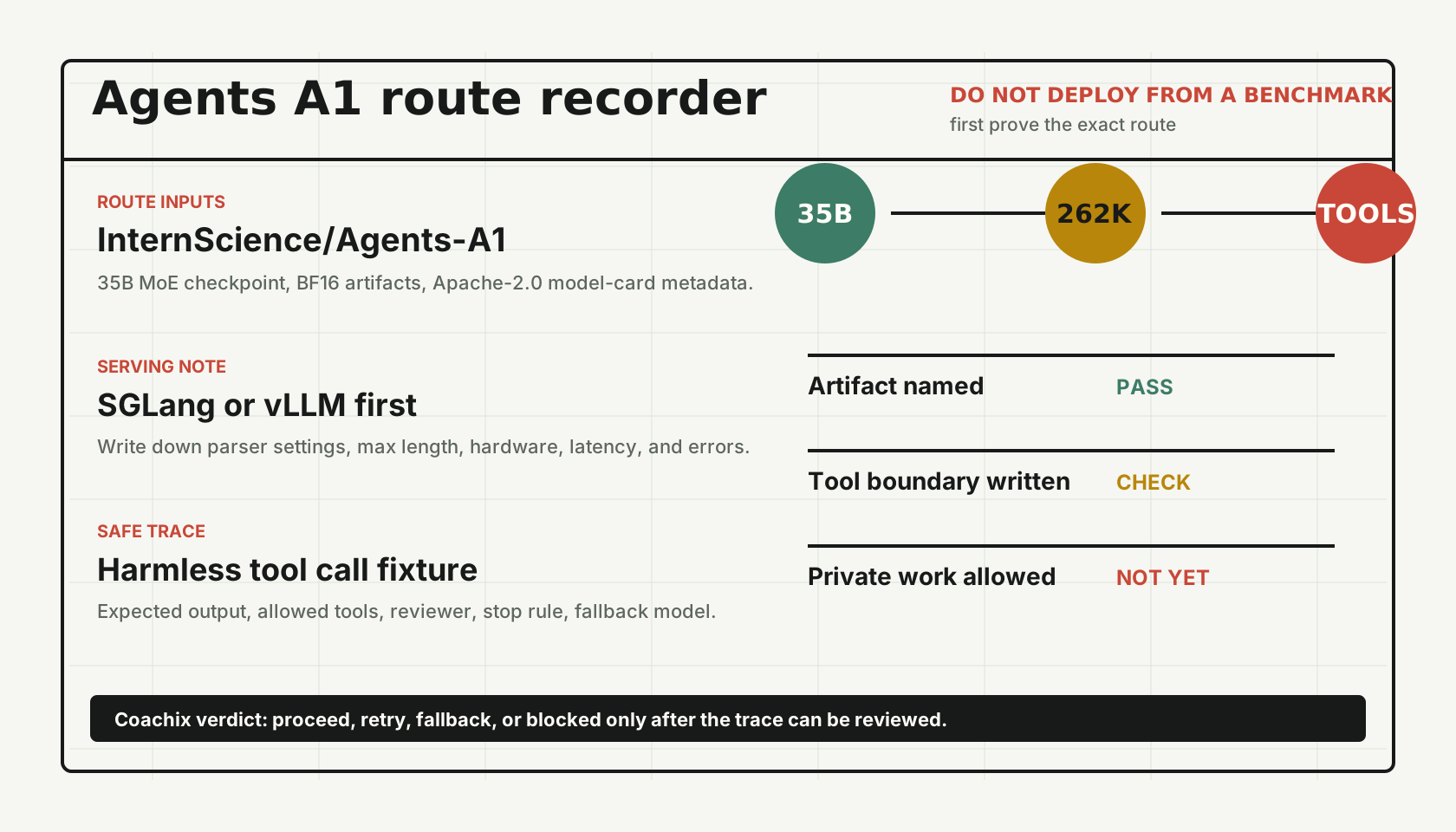
The practical numbers are 35B MoE, 262K served context, Apache-2.0 model-card metadata, BF16 artifacts, and serving examples for SGLang or vLLM.
Start with the official SGLang or vLLM examples, then write down max length, parser settings, hardware, latency, and failure behavior.
Use a harmless tool-call or long-context fixture with an expected answer, review owner, stop rule, and fallback model.
A benchmark claim does not prove your private workflow, tool permissions, or local derivative. Those need a repeatable trace.
Coachix should hold the route note: artifact, runtime, sources, context budget, tool boundary, expected output, reviewer, and verdict.
Route map
Checked facts
Use these rows to separate official signals, upstream cards, research claims, and community friction.
| Model identity | Use InternScience/Agents-A1 for the 35B model-card route. The official page and Hugging Face page describe it as a 35B Mixture-of-Experts agentic model. InternScience Hugging Face / InternScience |
|---|---|
| Context and runtime | Official usage examples serve the model with SGLang or vLLM and show 262144 context-length settings plus OpenAI-compatible endpoints. InternScience InternScience / GitHub |
| Tool-call route | The official page says the model supports function calling and external tools; GitHub examples include tool-call parser settings for SGLang and vLLM. InternScience InternScience / GitHub |
| License and artifacts | The Hugging Face model card lists Apache-2.0 and BF16 safetensors for the 35B checkpoint; verify files and license terms before redistribution or client work. Hugging Face / InternScience |
| 4B and quantized interest | The project news and community discussion show demand for Agents-A1-4B and quantized or local routes. Treat those as separate routes from the 35B checkpoint. InternScience / GitHub PTT AI Art Hugging Face Community |
| Benchmark caution | The arXiv paper reports strong long-horizon and agent benchmark scores. Use those numbers as a reason to test the route, not as proof your workload will pass. arXiv LLM Reference |
Decision helper
Start here when a note just says Agents A1. Pin InternScience/Agents-A1, Agents-A1-4B, a GGUF or MLX quantization, or another derivative before testing.
Safe sequence
Write the exact route: 35B model card, 4B model, quantized local package, or hosted derivative.
Choose one harmless fixture with an expected output, tool boundary, context budget, and reviewer.
Run the smallest useful trace first, then record prompt, context size, tool calls, latency, failures, and fallback.
Only move private sources, paid infrastructure, or public delivery into the route after the trace is understandable and repeatable.
Field guide
The broad Agents A1 search can mean a paper, a 35B model card, a GitHub serving route, a 4B route, or a quantized local package. The first job is to name the route. A page that jumps straight to benchmark claims leaves the builder guessing which artifact will actually run.
The 35B checkpoint is the serious route to test when the workload needs long-horizon planning, search, tool use, engineering repair, or scientific research. Keep the trace small at first. A useful first result is not a dramatic answer; it is a run where the prompt, context, tool calls, observations, failure behavior, and fallback can be inspected.
The 4B and quantized routes answer a different question. They are useful when a developer wants a lighter desktop or local experiment, but they should not inherit every 35B claim. Record the exact package, quantization, context setting, runtime, and hardware before comparing output.
Coachix fits after the model name is resolved. Bring the sources, fixture, context budget, tool boundary, expected output, reviewer, and fallback into the console so the first test becomes a route note rather than a half-remembered model recommendation.
Copyable handoff
Evaluate Agents A1 for one agent workflow. Use only the supplied current sources. Identify the exact model route, serving runtime, context budget, tool-call requirement, first synthetic task, expected output, permission boundary, latency or hardware risk, benchmark claims to ignore until reproduced, fallback model, and a proceed, retry, fallback, or blocked verdict. Do not invent provider availability, pricing, benchmark wins, file compatibility, or production permission that is not visible in the current sources.
FAQ
Agents A1 usually refers to InternScience/Agents-A1, a 35B MoE agentic model for long-horizon search, engineering, scientific research, instruction following, and tool use.
Use InternScience/Agents-A1 for the 35B Hugging Face route. Keep Agents-A1-4B, GGUF, MLX, and other quantized derivatives as separate routes.
Yes. The official usage examples show vLLM and SGLang serving commands with OpenAI-compatible endpoints and 262144 context settings. Verify hardware and framework versions before a serious run.
It is positioned for tool use and function calling. Prove it with a harmless tool-call fixture before real APIs, code execution, or account permissions enter the workflow.
Only after a repeatable trace shows it improves the exact route. Keep a fallback model for routine chat, cheaper worker tasks, or environments where serving the route is too heavy.
Related Coachix pages